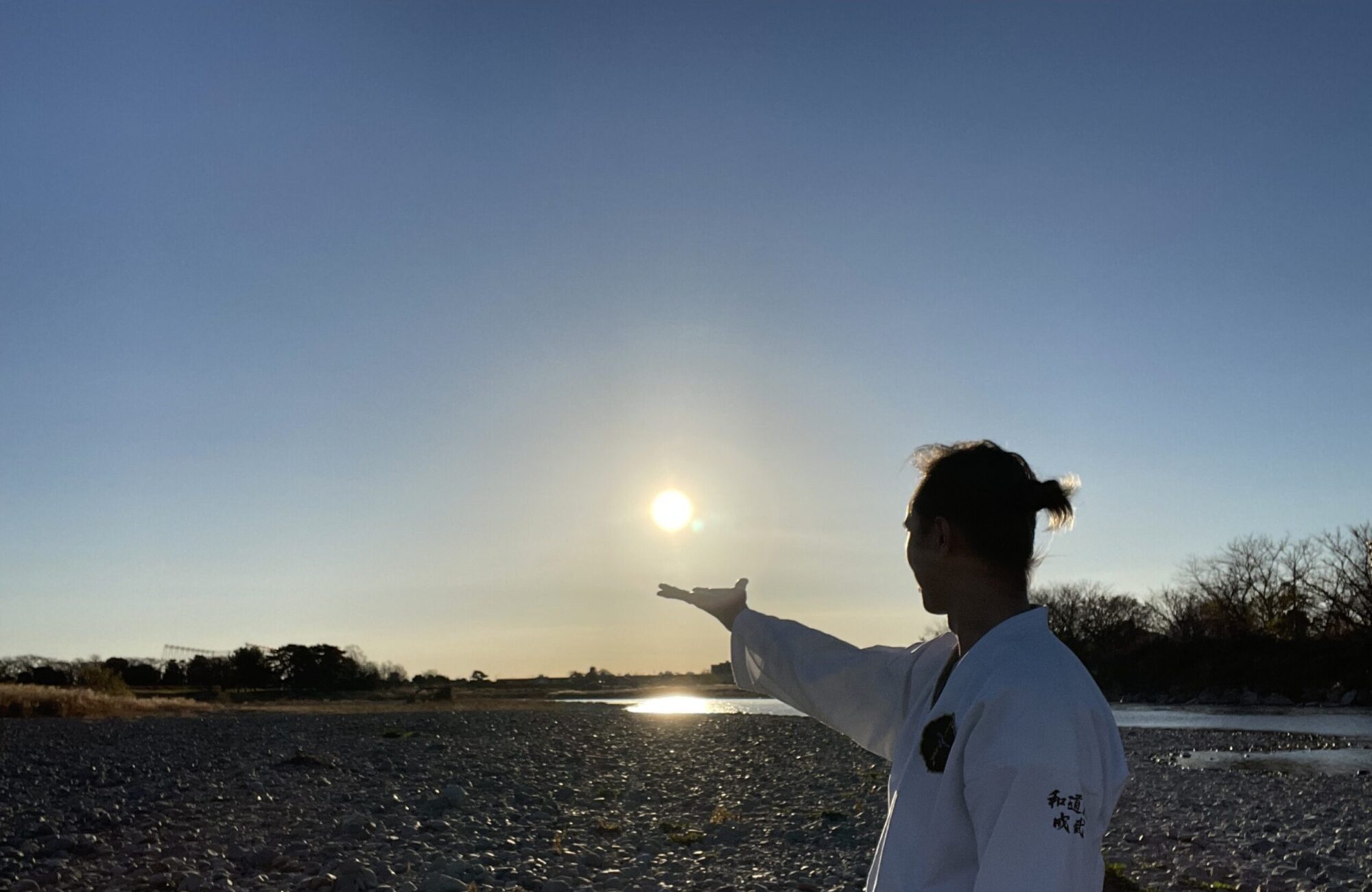
As I practice swinging a real sword,I often reflect on the people of the past—both those who pointed the blade at others and those who had it pointed at them—and the thoughts they harbored. There were those who craved combat and war, seeking to distinguish themselves in battle to gain honor, status, and reward;yet there were also those who shunned conflict—people who found happiness simply in having work to sustain them,savoring even a meager meal, finding shelter from the elements, and sleeping in peace. Then there were those who threw themselves into battle precisely to protect such people and their way of life. I believe that the essence of Budo lies in the aspiration to cultivate one’s mind,technique, and body—nurturing them to health—in order to protect the people and things we hold dear. It embodies the wish that we cherish life—both our own and that of others—and that people across the globe join hands to achieve inner peace and harmony. I am certain that the forebears who pioneered Budo on this earth continue to watch over the new lives being born into the world from the heavens above.
(Insert Song) 『Warabi Gami(Child of God)』 Word by Misako kojya Music by Kazuya sahara Song by Minami Kizuki We receive blessings from heaven and on this Earth Our newborn child, I pray and raise you Ira Yo Hei Ira Yo Hoi Ira Yo, my beloved child Don’t cry, oh dear Hey Yo Hey Yo Bask in the sunlight Thrive, my dear Hey Yo Hey Yo Grow strong and healthy
Mark Sensei, Micha Sensei, 日本に来てくれて私との稽古を楽しんでくれて本当にありがとうございました。 2年前に東京で開催した国際交流稽古会で初めてお会いした和道流オランダのGertjan Martens Senseiとはすぐに心が繋がったことを覚えています。私に対して伝えたいことや想いが私の中に明確に入ってくる特別な感覚を私は体験しました。私は貴方のことを決して忘れません。 もうひとつ大切なこと。
本日、アメリカ合衆国ハワイ州ホノルルで偉大な空手道の先生の葬儀が行われました。私は参列することは出来ませんでしたが、これまでのご恩に報いたく11月22日に開催される『The Final All Hawaii Championships』に選手と審判として参加し微力ながら成功に向け尽力し、その後は展墓し感謝の気持ちを伝えて参ります。
『Japan-Netherlands Exchange Training Session: Practicing shared body mechanics—specifically center-of-gravity shifting and the rotation of the supporting leg—across the progression from Kihon to Kata, Kata to Kihon Kumite, Kihon Kumite to Tachi Dori, and Tachi Dori to Kumite』 Two practitioners from Wado-ryu Netherlands joined class on 27th Sep.
Although the training venue is only a five-minute bus ride from our meeting point at the station, we learned that the next bus wouldn’t arrive for another fifteen minutes. So, treating the walk as a warm-up before training, the three of us decided to hike up the hill on foot—a twenty-minute journey. Along the way, we shared many fond memories of a great sensei who had passed away on last year yesterday. Mark Sensei and Micha Sensei, thank you so much for coming to Japan and enjoying our training sessions together.
I remember instantly connecting with Gertjan Martens Sensei of Wado-ryu Netherlands when we first met at an international exchange training event in Tokyo two years ago. I experienced a unique sensation where his thoughts and the message he wished to convey resonated clearly within me. I will never forget you.
One more important matter: Today, the funeral for a great Karate-do sensei was held in Honolulu, Hawaii. Although I could not attend in person, I wish to honor the debt of gratitude I owe him. To that end, I will participate as both a competitor and a referee in “The Final All Hawaii Championships” on November 22nd, doing my utmost—however humbly—to ensure the event’s success. Afterward, I will visit Sensei’s grave to express my heartfelt gratitude.
今回の動画の挿入歌には「You know the road is to tomorrow. Will you ride along with me again ?」という歌詞があります。生徒たちと仲間たちの顔が私の頭の中に浮かび、「この道は明日へと続いてる。君はまた私と一緒に稽古をしてくれるかい?」と和訳しました。私には私を信じてずっと一緒に稽古してくれる生徒たちと仲間たちがいるので、諦めることなくこれからも研究と稽古そして挑戦を続けて行きます。
The 62nd Wado-ryu Karate-do Renmei National Tournament was held at the Tokyo Budokan over two days, August 29 and 30. Sixteen competitors from our team participated, with six achieving top placements.
・Katsuhisa Tomitaka : 1st place (Men’s Jukuren Kumite Division), 2nd place (Men’s & Women’s Jukuren Kata Division), 3rd Place (Kihon Kumite Division)
・Mika Shinoaki : 1st place (Women’s Jukuren Kumite Division), 5th place (Men’s & Women’s Sounen Kata Division)
・Iwao Takeshita: 5th place (Men’s Jukuren Kumite Division), 3rd place (Men’s & Women’s Sounen Kata Division), 3rd Place (Kihon Kumite Division)
・Yui: 5th Place (9-10 years old girl’s Kata Division)
・Shion: 5th Place (9-10 years old girl’s Kata Division), (9-10 years old girl’s Kumite Division)
・Tsubasa: (9 years old boy’s Kata Division)
After the final match of the Men’s Jukuren Kumite division, several people asked me, “Why did you attack so aggressively?” so I would like to explain my reasoning here. I won the Men’s Jukuren Kumite division at the 9th International Tournament and 60th National Tournament (held in 2024 to commemorate the 90th anniversary of the school’s founding), receiving the “Black Medal” and the rank of Jin-i from the Grandmaster Ⅲ Hironori Ohtsuka Sensei. Link here 👇 https://youtu.be/8h5b_pybY_w?si=liRTzHP7jSE6Efsu
For the Men’s Jukuren Kumite division at the 61st Wado-ryu Karate-do Renmei National Tournament held the following year (2025), I entered the competition with the determination to showcase movements and techniques that surpassed those of the previous year. I focused on the Wado-ryu principles of noru, nagasu, and inasu, while aiming for go-no-sen or sen-no-sen.
Link here ① 👇 https://youtu.be/E2SANOBQ3cM?si=ucBriVEE7dOvpyRn
Link here ② 👇 https://youtu.be/wOIBEOsyKmo?si=8keQjNYhUDZ7fJ03
Although I was able to execute the movements and techniques I had envisioned, I lost the final by decision, and the Grandmaster Ⅲ Hironori Ohtsuka Sensei, determined that no one merited the “Black Medal” on that occasion. Immediately after the match, an assistant technical judge remarked, “I thought you would attack more,” which led me to reflect deeply: “Oh, was I expected to attack this time?”
Over the following year, as I have shown in previous videos, I have continued to research and train for the Wado-ryu Jukuren Kumite division using a variety of methods. Although the match duration for the “Jukuren Kumite Division” is a mere one minute, there have frequently been instances where both competitors—too cautious to gauge their opponent’s intentions—remain motionless or exchange very few techniques until time runs out. Furthermore, the judging criteria evaluate whether one’s body mechanics correctly facilitate actions such as “deflecting, evading, and riding”, “shifting position, body, and technique,” and achieving “unity of attack and defense” or “freedom of attack and defense.” Unless one party takes the initiative to attack or move, these elements cannot manifest during the match. My reason and motivation for constantly attacking this time stemmed from a desire to realize the true essence of “Wado-ryu Kumite” together with my opponent; I wanted to create a scenario where they, too, could demonstrate those vital principles—deflecting, evading, riding, shifting, and the seamless integration of attack and defense.
However, that approach did not yield the “correct” answer. Although I won the championship, Grandmaster Ⅲ Hironori Ohtsuka Sensei once again determined that no one was worthy of the “Black Medal.”
The insert song in this video contains the lyrics: “You know the road is to tomorrow. Will you ride along with me again?” As the faces of my students and fellow practitioners came to mind, I translated the sentiment as: “This path leads to tomorrow. Will you train with me again?” Because I have students and colleagues who believe in me and train alongside me, I will continue to research, practice, and take on new challenges without ever giving up.
Finally, a message to my students and colleagues who believe in me and train hard by my side: Thank you for your efforts at the national tournament. After returning home, I watched the match footage of each one of you. I saw you boldly moving forward. As you grow—not only in matches but in life—the obstacles standing in your way will become larger; please move forward powerfully with a spirit of determination, facing adversity head-on. I know that you are capable of putting in the effort without being discouraged by anything. After all, you are my students, my cherished colleagues, and my family. Let us continue to strive together for the pinnacle of gentleness, walking the path of loving others with a heart that loves itself.
Friday, August 21, 2026 For the past twenty years, my dojo has offered classes limited to six students each, and I train seven days a week with a total of 123 students. More than half of them are women; they do not attend the dojo merely as a casual hobby. They do not giggle or smile frivolously during practice; instead, they train earnestly toward their goals and boldly face me in sparring without flinching. I am truly proud of them. Age and gender make no difference when it comes to the determination and effort required to embody the desire to be strong and to protect what is precious. My own mother was a very strong woman who protected me, my brother, and my sisters when we were young; even now, at over eighty years old, she says, “I want to walk on my own two feet and create things with my own hands. I want to keep living with dreams, never forgetting the wonderful memories and the importance of gratitude.” I also feel deep gratitude toward my “Hawaiian mother”—a woman I respect and cherish just as much as my own—because it was from her that I learned the true nature and conduct of a human being.
Sunday, August 23, 2026 Today marked the final day of the joint intensive training sessions that began on Sunday, July 19, in preparation for the 62nd Wado-ryu Karate-do Renmei National Tournament, scheduled for August 29 and 30. We started training at 9:00 a.m., beginning with a review of stances, body mechanics, and the control of speed and rhythm for 14 KATA, while also analyzing specific techniques and movements. Everyone performed the required KATA 27 times; before we knew it, over two hours had passed. Finally, we engaged in five KUMITE matches against different partners to refine our sense of distance, timing, tactical maneuvering, and the execution of techniques. We were able to complete the entire training program without a single injury. It has been a highly productive month, and I am in peak condition—both mentally and physically. For the next five days, I intend to focus on maintaining this state.
Sunday, August 16, 2026 We held a joint intensive training session at the Yurigaoka Karate-do Club branch dojo of the Wado-ryu Karate-do Renmei in preparation for the 62nd National Tournament. A full month has passed since we began on Sunday, July 19; while fatigue has reached its peak, we are in excellent condition—mentally, technically, and physically. With only ten days remaining until the tournament, we will now focus on avoiding overtraining and fine-tuning our minds and bodies to ensure we enter the competition in peak form.
【17th Summer Training Camp: Day on 7〜9th Aug 2026】 My beloved summer training camp has come to an end. The three days spent with the students and cherished fellow practitioners—with whom I share a love for the art of Karate—have left me with irreplaceable memories and experiences. I am more determined than ever to devote myself fully to doing everything I can and everything required of me until the day my students graduate from my instruction. I offer my heartfelt gratitude to God, my master, and my parents for guiding me onto the path of Karate.
Sunday, August 2, 2026 This morning, we held another intensive training session in preparation for the 62nd National Tournament of the Wado-ryu Karate-do Renmei, scheduled for the end of this month. Despite the early hour, my students showed no signs of drowsiness; instead, they demonstrated a genuine eagerness to train. My role is not merely to prepare an excellent program, but to foster in my students the ability to anticipate potential situations, devise ways to overcome them, and respond effectively. I am convinced of this because it is a lesson I learned through Karate-do—a skill that has helped me navigate crises and employ successful tactics during competitions. Even in the sweltering heat of a dojo without air conditioning, my students remained focused and trained diligently, with not a single person suffering from any health issues.
With only five weeks remaining until the 62nd National Tournament of Wado-ryu Karate-do Renmei, we began our annual joint intensive training sessions today. We were blessed with clear weather this morning, but the heat inside the gymnasium—which lacks air conditioning—was intense; nevertheless, everyone stayed focused on their training without faltering. I truly admire the students who join me in studying and practicing challenging concepts: shifting the center of gravity; external and internal leg rotation; compression and expansion; rotational movements in opposing vertical directions; Mahanmi-no-neko-ashi-dachi and footwork; rapid changes of direction; and the interplay between abdominal pressure, the center of gravity, and the tanden. For children, summer vacation is undoubtedly a time when they want to play to their heart’s content. Yet, they set that desire aside to participate in training because each of them has a goal. I am fully committed to supporting and assisting them in their efforts.
1988年9月、当時10歳だった私は空手の道の入門を許され、生涯の師と仰ぐ瀬田松弘昌先生に出会い師事しました。瀬田松先生の師匠は、和道流の流祖である大塚博紀初代宗家で、瀬田松先生は大塚初代宗家の話を私に沢山して下さいました。それは終戦後、当時20代前半の瀬田松先生は大塚初代宗家の元を訪ねた際、大塚初代宗家は温かく迎えてくれて熱心に稽古をつけてくれて決して忘れることのない日々になった話や瀬田松先生の地元である函館に大塚初代宗家を招き稽古をつけてもらった話、30代前半で故郷を離れる決意をし上京して和道流空手道・柔術拳法の総本部道場に入門し大塚初代宗家の直弟子となって稽古に励まれた日々の話、大塚初代宗家の自宅を訪れる時に持参した和菓子を毎回喜んで食べてもらった話、大塚初代宗家の直弟子たちは皆強く、総本部道場に腕試しに来た者たちは帰る時は全く違う態度と身体の状態になっていた話、大塚初代宗家の教えを一つも忘れまいと寝ずに稽古に励んだ翌日、大塚初代宗家から「昨日教えたことは忘れて。もっと良いことを思いついたから変える。今日覚えて。」と言われ、直弟子たち皆必死になって覚え直した日の話。 瀬田松先生が大塚初代宗家の話をする時はいつも笑顔でした。その笑顔を見ると私は「大塚初代宗家も瀬田松先生も直弟子の方々も、皆んな毎日が楽しくて充実してたんだろうな。師匠の大塚初代宗家が和道流という素晴らしい武道を生み、より良くしようと創意工夫を重ねる姿を瀬田松先生も直弟子の方々はそばで見ていて、『自分たちも協力したい!力になりたい!お役に立ちたい!』って思っていたんだろうなあ。」と想像し、一緒になって楽しく嬉しい気持ちでいっぱいでした。 瀬田松先生は2017年11月14日に天に召され、私は師匠に会うことも話すことも出来ません。しかし、不思議なことに言葉が降りてくる感覚を何度も持ったことがあります。武道が大好きな方々同様に、私も四六時中和道流のことを稽えています。歩いてる時も、食事中も、テレビを見ていたり、本を読んでいても、『基本が何に繋がり、何を生み出せるか』と稽えていると、突然、閃く瞬間が訪れたり、夢の中に大塚初代宗家や瀬田松先生が現れて、私に稽古をつけてくれることがあるのです。 時が何年経っても、お姿は見えなくなっても、先人たちは私たちに伝えたいことがあるに違いありません。私はその想いに触れたいし、理解したいし、実現したいと思っています。 『武の道はただ荒事とな思ひそ 和の道究め和を求む道』 In September 1988, at the age of ten, I was accepted into the world of karate and began studying under Master Hiromasa Setamatsu, whom I would come to revere as my lifelong mentor. Master Setamatsu’s own teacher was Hironori Otsuka, the First Soke and founder of Wado-ryu; he often shared stories about the founder with me. He told me about visiting the First Soke in his early twenties—just after the war—and being warmly welcomed and coached with such passion that the experience became unforgettable. He spoke of inviting the First Soke to his hometown of Hakodate for training sessions; of leaving home in his early thirties to move to Tokyo, where he joined the Wado-ryu Karate-do and Jujutsu Kenpo headquarters dojo, became a direct disciple, and devoted himself to training; and of how the First Soke always delighted in the Japanese sweets he brought when visiting his home. He recounted how the First Soke’s direct disciples were formidable martial artists—so much so that challengers who came to the headquarters dojo to test their skills would leave with completely different attitudes and physical conditions. He also shared a story about a day when, after staying up all night training to ensure they wouldn’t forget a single one of the First Soke’s teachings, the master told them, “Forget what I taught you yesterday. I’ve come up with something better, so we’re changing it. Learn this instead”—prompting all the direct disciples to scramble to learn the new method. Master Setamatsu always smiled when he spoke of the First Soke. Seeing that smile, I would imagine the lives they led: “The First Soke, Master Setamatsu, and all the direct disciples must have found every day joyful and fulfilling. Watching their master—the First Soke—create the magnificent martial art of Wado-ryu and constantly innovate to refine it, they must have felt a burning desire to cooperate, to lend their strength, and to be of service.” Imagining this filled me with a sense of shared joy and happiness. Master Setamatsu was called to heaven on November 14, 2017; I can no longer meet or speak with my mentor. Yet, strangely enough, I have often experienced moments where insights—words of wisdom—seem to descend upon me. Like all true lovers of martial arts, I contemplate Wado-ryu constantly. Whether I am walking, eating, watching television, or reading a book, if I am pondering the nature of the fundamentals—what they connect to and what they can create—sudden flashes of inspiration occur. At times, the First Grandmaster Otsuka or Master Setamatsu even appear in my dreams to instruct me. No matter how many years pass or how their physical forms fade from sight, our predecessors surely have things they wish to convey to us. I desire to touch upon those sentiments, to understand them, and to bring them to fruition. “Do not mistake the martial path for mere violence; it is a path of seeking harmony through the mastery of the Way of Harmony.”
Yesterday, I held the “Wado-ryu Karate-do 3rd Kanagawa Prefecture Tournament Wado-ryu Seibu Team Victory Celebration Party,” and I was able to bring “smiles” to the children’s faces. Not only this time, but always, I would like to express my heartfelt gratitude to Shigeru Tsuiki Senpai and Sensei Hiroko Kotaka for their thoughtfulness and support for me, my family, and my students. 31 years ago, when I was a high school student, I first met Tsuiki Senpai when I visited the university’s karate club for training. From that time on, he sparred with me, and when I had important tournaments such as international competitions coming up, he would come to my dojo and spar with me. He cares not only for me but also for my family and students, and he is truly a kind-hearted older brother figure who personally delivers lots of drinks and jelly to tournament venues and training camps. 18 years ago, one of my students set the goal of “becoming a world-class athlete,” and I decided to support him in achieving that goal by traveling to the world’s top international tournament. I called Hiroko Sensei, who lives in Hawaii, and asked if I could participate in the “All Hawaii State Karate Championships Honolulu International Karate Championships,” which she hosts every November. Hiroko Sensei, despite never having met me before, was incredibly kind and helpful, and both my student and I were able to participate. At the seminar the day before the tournament and at the tournament venue on the day itself, Hiroko Sensei, along with Chuzo Kotaka Sensei, his daughter Mari Sensei, and his son George Sensei, warmly welcomed us, allowing us to experience many things in a serious yet enjoyable way. There’s a phrase I’ll never forget. When I asked Hiroko Sensei, “Why are you all so kind to us?”, Hiroko Sensei replied with a gentle smile, “We simply want to support young people like you who are working hard in local dojos. When we first came to Hawaii, we didn’t know anyone and were completely clueless. But as we continued, one person after another extended a helping hand. We haven’t forgotten what they did for us, and now we’re simply doing what they did for us.” I will never forget what Tsuiki Senpai and Hiroko Sensei did for me. I will continue to think carefully about my students and myself, strive to grow, and dedicate myself to exploring and realizing ways to make the world a better place through Budo.