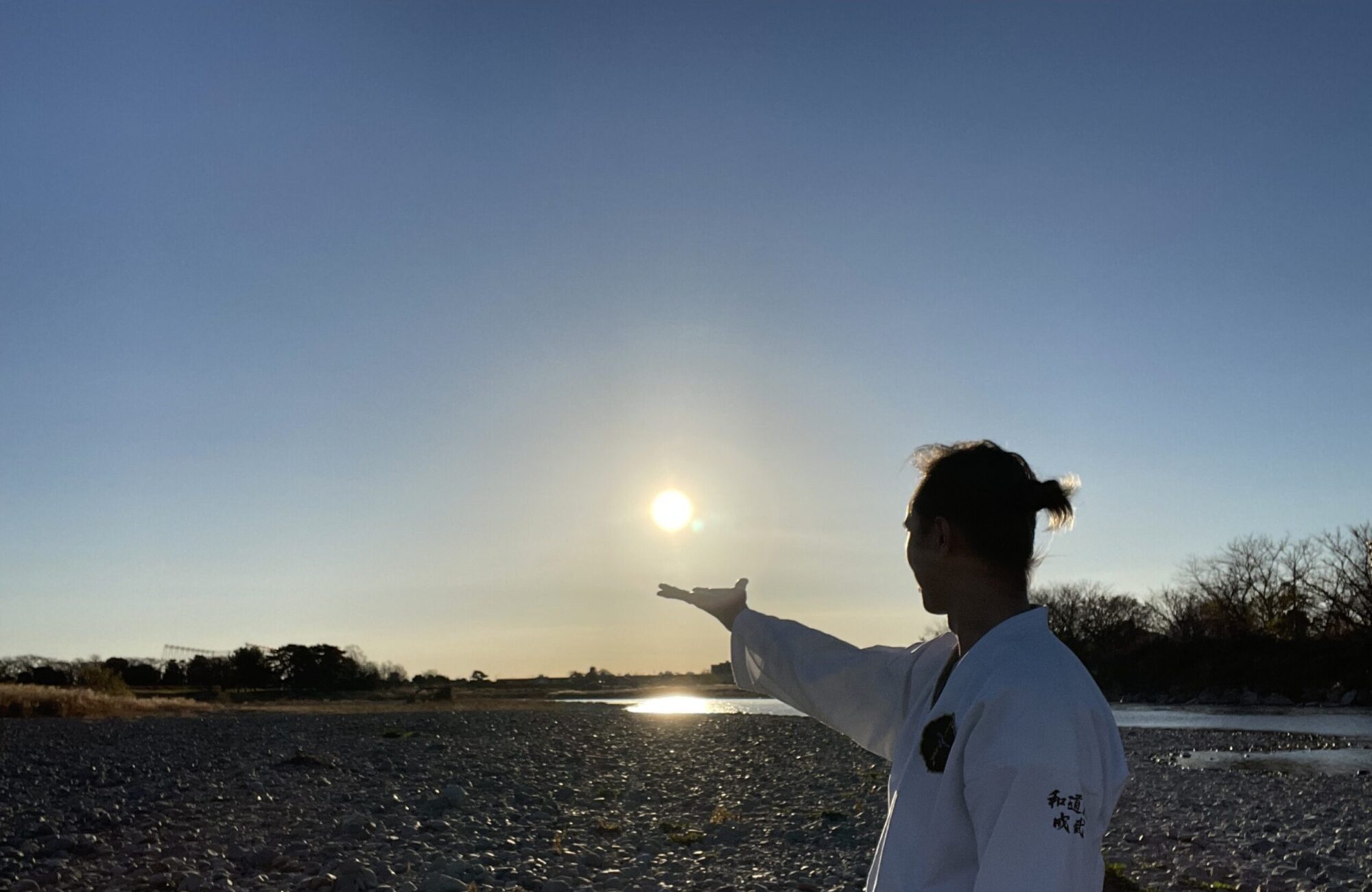
As I practice swinging a real sword,I often reflect on the people of the past—both those who pointed the blade at others and those who had it pointed at them—and the thoughts they harbored. There were those who craved combat and war, seeking to distinguish themselves in battle to gain honor, status, and reward;yet there were also those who shunned conflict—people who found happiness simply in having work to sustain them,savoring even a meager meal, finding shelter from the elements, and sleeping in peace. Then there were those who threw themselves into battle precisely to protect such people and their way of life. I believe that the essence of Budo lies in the aspiration to cultivate one’s mind,technique, and body—nurturing them to health—in order to protect the people and things we hold dear. It embodies the wish that we cherish life—both our own and that of others—and that people across the globe join hands to achieve inner peace and harmony. I am certain that the forebears who pioneered Budo on this earth continue to watch over the new lives being born into the world from the heavens above.
(Insert Song) 『Warabi Gami(Child of God)』 Word by Misako kojya Music by Kazuya sahara Song by Minami Kizuki We receive blessings from heaven and on this Earth Our newborn child, I pray and raise you Ira Yo Hei Ira Yo Hoi Ira Yo, my beloved child Don’t cry, oh dear Hey Yo Hey Yo Bask in the sunlight Thrive, my dear Hey Yo Hey Yo Grow strong and healthy
Friday, August 21, 2026 For the past twenty years, my dojo has offered classes limited to six students each, and I train seven days a week with a total of 123 students. More than half of them are women; they do not attend the dojo merely as a casual hobby. They do not giggle or smile frivolously during practice; instead, they train earnestly toward their goals and boldly face me in sparring without flinching. I am truly proud of them. Age and gender make no difference when it comes to the determination and effort required to embody the desire to be strong and to protect what is precious. My own mother was a very strong woman who protected me, my brother, and my sisters when we were young; even now, at over eighty years old, she says, “I want to walk on my own two feet and create things with my own hands. I want to keep living with dreams, never forgetting the wonderful memories and the importance of gratitude.” I also feel deep gratitude toward my “Hawaiian mother”—a woman I respect and cherish just as much as my own—because it was from her that I learned the true nature and conduct of a human being.
Sunday, August 23, 2026 Today marked the final day of the joint intensive training sessions that began on Sunday, July 19, in preparation for the 62nd Wado-ryu Karate-do Renmei National Tournament, scheduled for August 29 and 30. We started training at 9:00 a.m., beginning with a review of stances, body mechanics, and the control of speed and rhythm for 14 KATA, while also analyzing specific techniques and movements. Everyone performed the required KATA 27 times; before we knew it, over two hours had passed. Finally, we engaged in five KUMITE matches against different partners to refine our sense of distance, timing, tactical maneuvering, and the execution of techniques. We were able to complete the entire training program without a single injury. It has been a highly productive month, and I am in peak condition—both mentally and physically. For the next five days, I intend to focus on maintaining this state.
When I asked Mike Sensei, “I want to show my students Budo kumite, not competitive kumite, just like we did in the finals of the international tournament two years ago, so would you be willing to Kumite with me?”, he readily agreed. I have always hoped for a world where people of all nationalities, religions, skin colors, ages, and genders can join hands and share the effort and significance of creating harmony, and I believe that the path of Budo is what has been given to me to make that a reality.
《引き手と突きについて稽える》 Considering about HIKITE and TSUKI 腹圧、仙骨、広背筋、菱形筋、上腕二頭筋、前鋸筋・小胸筋を意識することや連動を感じることが出来る準備運動 Warm-up exercises that allow you to be aware of and feel the coordination of abdominal pressure, sacrum, latissimus dorsi, rhomboids, biceps brachii, serratus anterior, and pectoralis minor muscles. 腹圧を高め仙骨を立て足裏で床を押す。 Increase abdominal pressure, straighten your sacrum, and press your soles into the floor. 力が膝、股関節、骨盤へ伝わる。 The force is transmitted to your knees, hips, and pelvis. そこから胸椎の回旋につながる。 From there, it leads to rotation of the thoracic spine. 最後に肩、肘、拳へ抜けていく。 Finally, it exits through your shoulders, elbows, and fists. みぞおちの奥あたりが、軽く左右に「ねじれる」感覚がある。 You should feel a slight “twisting” sensation deep in your solar plexus. 肩だけ、腰だけではなく、胸の真ん中から動きが始まる感じがある。 The movement should feel like it’s starting from the center of your chest, not just your shoulders or waist. 息を止めず、軽く吐きながら動くことで胸郭が固まりすぎない。By moving while gently exhaling without holding your breath, your rib cage won’t become too stiff. 《抱え込みと蹴りについて稽える》 Considering about KAKAEKOMI and KERI 大腰筋、腸骨筋を意識し下半身を安定させて体幹を締める準備運動 Warm-up exercises that focus on the psoas major and iliacus muscles to stabilize the lower body and tighten the core. 腰を大きく回し切るよりも、三〜四割ひねる程度の意識 Rather than rotating your hips completely, focus on twisting them about 30-40% of the way. 脚はタイヤ、腰はハンドルだとイメージします。 Imagine your legs as the tires and your waist as the handlebars. 蹴る前と蹴った後の踵は軸脚の膝内側に寄せる。 Before and after KERI, bring the heel close to the inside of the knee of the supporting leg. 《行雲流水》 like floating clouds and flowing water 私の動画で度々登場する風船 Balloons often appear in my videos 私にとっては、稽えさせてくれる要素が沢山あります。 For me, there are many elements that allow me to learn. 容易いようで膨らませるのは簡単ではない風船 Balloons seem easy to inflate, but they’re not. 武道の普及と発展や、知恵と想像力も似てる気がします。 The spread and development of martial arts, as well as the expansion of wisdom and imagination, are equally difficult tasks. でも互いに触れ合うと広がろうとするエネルギーを感じます。 But when we touch each other, I feel an energy that seems to be spreading. あとはどうやって伝えるかを稽え探求します。 The next step is to practice and explore how to communicate effectively. 自分は居着かず相手を居着かせる術を稽えています。 I’m considering the art of not staying put myself, but rather making others stay put. 《1+1+1=1》 trinity 《これらを自由組手の中で実践》 These techniques are put into practice during free sparring 私はメダルや賞賛を得るために競技しているわけではないし、名誉や誇りをかけたりしていません。武道を生み切り拓いた先人たちの精神と私自身を含め人間を深く知りたいと思っています。 I don’t compete to win medals or receive praise, nor do I stake my honor or pride on it. I want to deeply understand the spirit of the pioneers who created and pioneered martial arts, and also understand humanity itself, including myself. 国籍、宗教、肌の色、老若男女問わず、互いに手を取り合い調和を生むための努力とその意義を共有し合える世界を私は望み続けており、実現するために与えられたのが武の道だと信じています。 I have always hoped for a world where people of all nationalities, religions, skin colors, ages, and genders can join hands and share the effort and significance of creating harmony, and I believe that the path of martial arts is what has been given to me to make that a reality.
① 自作の『時機読力向上器具』”ローリー”で流れやタイミングをつかんで、「今やる/まだ待つ」を判断する能力の向上を目指します。 Using my self-made “timing-reading device” “Laurie,” I aim to improve my ability to grasp the flow and timing, and to judge whether to “act now” or “wait.”
② ラダーで細かいフットワークを連続して行うことで、脳から筋肉への指令がスムーズになり、動きの反応速度が上がります。 Performing a series of short, precise footwork drills on a ladder improves the smooth transmission of signals from the brain to the muscles, increasing reaction speed.
③ フットワークを用いることで相手との間合いを測ることが出来たり、床反力を利用することで動き始めを素早くすることが出来ます。 Using footwork allows you to close or widen the distance between you and your opponent, and utilizing ground reaction force allows you to start moving quickly.
④ これは2005年に出場した世界大会から4年後に開催された国際大会の映像です。31歳の私は勝利を掴むこと以上に、「応援してくれる生徒たちと共に闘うチームメイトと観客の胸に響く試合を対戦する相手と見せたい」という想いで挑みました。 This is footage from an international competition held four years after the World Championships in 2005. At 31 years old, my motivation for competing was less about achieving victory and more about “creating a match that would resonate with my students who support me, my teammates, and the audience, and show them a game that would touch their hearts.”
⑤ 相手の動きに惑わされずに自分の律動を保つ心身を養います。 This helps cultivate a mind and body that can maintain their own rhythm without being swayed by the opponent’s movements.
⑥ 脳から最も離れている足指を刺激し脳の活発化を図ります。 By stimulating the toes, which are the furthest point from the brain, we aim to activate the brain.
⑦ 相手の体動だけでなく心動と考動に反応を目指します。 The goal is to react not only to the opponent’s physical movements, but also to their emotional and thought processes.
⑧ このような単純に見える運動を繰り返すことで、不安定の中で安定を作る能力が養われると考えています。 I believe that by repeatedly performing these seemingly simple movements, one can cultivate the ability to create stability in unstable situations.
⑨ 私は道場を開設した当初は生徒たちに「何を教えるか」を日々考えていました。それが次第に「どのようにして伝えるか」に変わり、それを機会に自分の身体を知る研究を始めました。それらを経て、また週7日毎日生徒たちと過ごす日々を20年続け、人生も半世紀生きて来て悟ったことがあります。彼らは私から教わるために道場に来ているのではなく、私の不変と可変を見続けていることです。私の向き合い方や関わり方、言動や行動が自分の心にどのような影響を及ぼすか彼らは自ら考えを巡らせて人間関係、未来、人生をより良いものにしようと努めています。 When I first opened my dojo, I spent my days thinking about “what to teach” my students. Gradually, that shifted to “how to convey it,” and that prompted me to begin studying my own body. After going through all of that, and continuing to spend 20 years spending 7 days a week with my students, and having lived half a century, I’ve come to a realization. They don’t come to the dojo to be taught by me; they come to observe my unchanging and ever-changing nature. They reflect on how my approach, my interactions, my words and actions affect their own hearts, and strive to improve their relationships, their future, and their lives.
⑩ これは2018年に出場したホノルル国際空手道選手権大会の映像です。41歳の私に主催者が「貴方なら出来る」とWKF世界大会に出場している選手たちが集う18歳以上有段者の部へ出場を勧めてくれました。 大きな期待が私に漲る力を与えてくれました。緊張している生徒に「私も挑戦するから一緒に闘おう」と声をかけ、共に成し遂げた後に過ごした素晴らしい時間と信頼関係はこれからも不変であるよう精進します。 This is footage from the Honolulu International Karate Championships in 2018. At the age of 41, the organizers encouraged me to compete in the 18+ black belt division, which features athletes who have competed in the WKF World Championships, telling me, “You can do it.” This great expectations placed upon me gave me immense strength. I encouraged my nervous students by saying, “I’m taking on this challenge too, so let’s fight together,” and I will strive to ensure that the wonderful time we spent together and the trust we built after achieving something together remain unchanged.
In demonstrations of board breaking, I confront my own mind, technique, and body, including these fundamentals of physical movement, in order to understand whether or not I have achieved a trinity of these three elements. I also hope that by showing the results that this state produces, along with my attitude and posture, it will give my students an opportunity to feel something or to practice.
This is footage from my second world championship. At 27 years old, before I opened my dojo, I trained for a total of eight hours a day: two hours before work, one hour during my lunch break, two hours after work, and three hours at the dojo. Back then, I felt a sense of accomplishment from pushing my body to its limits, and I think I was just trying to force my techniques on my opponents during matches.
Now, 21 years later, I prioritize creating an environment where students with worries and goals can find hints that will lead to problem-solving and goal achievement. In matches, I aim for a connection and harmony of mind, technique, and body not only with opponents but also with referees, staff, and spectators. —————————————- ⑤ 身体操作の基本を用いて突きを速くするトレーニングを稽える Fundamental body mechanics are used in my training to increase the speed of TSUKI
⑴ ゴムバンドで拳立て伏せ knuckle push-ups with a rubber band ⑵ ゴムバンドで突き TSUKI with a rubber band ⑶ メディシンボールを前後 Medicine ball back and forth ⑷ メディシンボールを左右 Medicine ball left and right ⑸ ラダーを横移動 Move sideways on the ladder ⑹ ラダーの上を跳ねる Jumping on a ladder —————————————- ⑥ 身体操作の基本を用いて蹴りを速くするトレーニングを稽える Fundamental body mechanics are used in my training to increase the speed of KERI
⑴ ラダーで膝上げ Knee raises on the ladder ⑵ ラダーで腰捻り Twist your waist on the ladder ⑶ ハードルを横跳び Jumping over hurdles sideways ⑷ ハードルを片脚跳び One-legged jump over hurdles ⑸ ボックス三段跳び Box Triple Jump ⑹ 腰高ボックス跳び Jump onto a box that is waist-high —————————————- ⑦ 身体操作の基本を用いて足捌きを速くするトレーニングを稽える Fundamental body mechanics are used in my training to increase the speed of Footwork
⑴ 反り跳び Backbend jump ⑵ 押し相撲 Sumo wrestling ⑶ ラバーロープ Rubber rope ⑷ アブローラーバーピー Ab roller burpees ⑸ 四方反り跳び Four-way backbend jump ⑹ 落球を避ける Avoid the falling medicine ball —————————————- ⑧ 5テクニクスドリル ⑴ 刻み突き ⑵ 裏廻し蹴り ⑶ 中段廻し蹴り ⑷ 中上 ⑸ 上中 —————————————- ⑨ 身体操作の基本を用いて反応を速くするトレーニングを稽える Fundamental body mechanics are used in my training to increase the speed of Reaction
⑴ ハイプランク姿勢でボールを片手で掴む High Plank & Ball Catch ⑵ 頭上に投げた風船が床に着く前にゴムバンドを取って戻る Balloon & Rubber Band Catch ⑶ 指示に従い左右回りまたは四股立ちまたは突きまたは風船取り Round & Freeze ⑷ 取って取られての中で誰よりも先に3つを獲得する Be the first to acquire three ⑸ 三目並べ Tic-Tac-Toe ⑹ 突きと蹴りを組み合わせた連続技 A combination of TSUKI and KERI ⑺ その連続技に対して体捌き Body movement against that combination of moves —————————————- ⑩ 打ち込み ⑴ 防御のみ ⑵ 体捌き ⑶ 1本勝負
During spring break, many students were absent from practice due to family trips and other reasons. However, I strongly hope that those who continue to attend the dojo every day will have meaningful training sessions. In my late teens, to maintain the operation of my karate club, I worked part-time at a convenience store in the early mornings before university classes began and late at night after classes and practice. I also worked as an apprentice at a sushi restaurant. At the convenience store, I was responsible for opening and closing the shop, managing inventory, and placing orders. Since it was in a less-than-safe area, I also had to focus on security. After winning an international tournament and returning home, the store manager invited me to his home and celebrated with a lavish meal.
At the sushi restaurant, as an apprentice, my duties were limited to cleaning, washing dishes, and serving customers hand towels and tea. One day, a heavy snowfall brought all trains and buses to a standstill. I walked for about an hour to the restaurant, and when I arrived, the owner said, “Oh! You’re here. I thought you’d call and say you’d take the day off because of the weather. I didn’t expect you to actually come.” From that day on, my master taught me the fundamentals of being a chef, one step at a time.
Building trust isn’t easy, but it’s true that if you have goals, work hard, and keep challenging yourself, “someone will be watching.” Now, I want to be someone who keeps a close eye on my students.
I don’t think there’s any need to make it unnecessarily complicated. If you’re sharing value and enjoyment with people who are interested, then simplicity is fine. The way people perceive the flashes of inspiration, surprises, and new possibilities that arise from that simplicity is different for everyone. I feel that a life in which I can share the appeal of Budo with people of all ages and genders is a treasure given to me by God.
Our first important event of the year took place on March 7th. It was my first opportunity in three months to perform a new piece, and my adorable students, ages 7 to 9, performed it. One girl, who had been anxious about not being able to complete the “Tile Breaking” (Kawara-wari) until the day before the performance, succeeded in the actual performance. Another girl, who had performed Kagura with me at the end of last year, took on a sense of responsibility and confidence as the oldest student and performed admirably. The following day, March 8th, was Sunday class practice day. The sky was clear, the temperature was just right, and the practice room was a tatami room, so I could feel the students’ enthusiasm. This month, we’re spending 14 days conducting promotion examinations for 60 students in 19 classes at six locations. To support students who are working hard not only at the dojo but also on their own in order to pass, we’re offering “Advice for Independent Practice.” Every day, I receive videos and questions from students, such as, “I’ve memorized the order of the kata, but I want the teacher to confirm that my stance is correct,” “There are parts of the stance and hand movements I don’t understand, so I’d like to ask the teacher,” and “If I understand the meaning of the kata movements, I can practice them more consciously, so please teach me.” “Parent, child, and teacher form a triumphant four-legged race” Even if others call me a “fossil-level analog person,” I want to share the importance of “facing each individual honestly.”